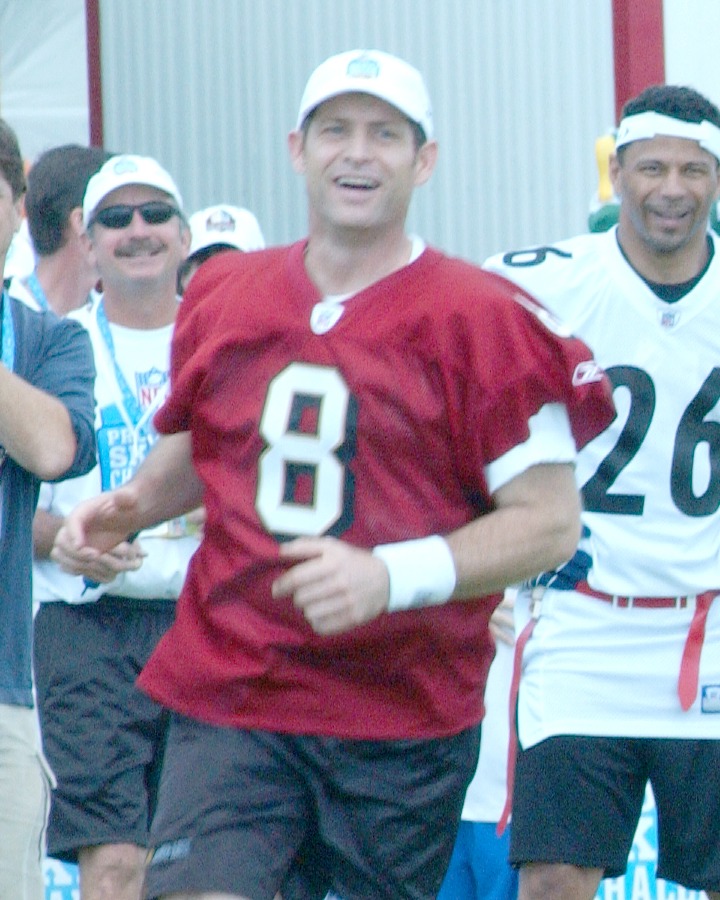
Steve Young
Four years holding the clipboard behind a legend, then two MVPs, a record six touchdown Super Bowl, and the lefty who finally made the boos stop.
The Steve Young Story
I'll admit something up front. For a couple of years there, a lot of us didn't want Steve Young. We wanted Joe. Everybody wanted Joe. And the kid who took the job from a legend had to drag an entire fan base kicking and screaming to the point where we figured out he might've been the most dangerous quarterback who ever wore the red and gold. By the time he was done, nobody was booing.
He was born in Salt Lake City on October 11, 1961, and grew up in Greenwich, Connecticut, a running quarterback in a high school offense that barely threw. He went to BYU, the school named for his great great great grandfather Brigham Young, and the coaches there actually thought about moving him to defensive back. He sat behind Jim McMahon, worked on his throwing, and then as a senior in 1983 he threw for 3,902 yards and 33 touchdowns and completed 71.3 percent of his passes, an NCAA record at the time. He was a unanimous All American, won the Davey O'Brien Award and finished second in the Heisman voting.
Then things got weird. Instead of the NFL he signed with the Los Angeles Express of the USFL in 1984 for a deal billed at $40 million, the biggest contract in sports. He became the first pro player ever to throw for 300 yards and run for 100 in the same game. By 1985 the franchise was falling apart around him. The team went 3 and 15, the league stopped paying to replace injured players, and in the final game at Orlando he had to line up at tailback because there were no healthy running backs left.
Tampa Bay held his NFL rights after taking him first in the 1984 supplemental draft of USFL and CFL players, so that's where he went next. It was a disaster. The Bucs went 2 and 14 in both of his seasons there, he went 3 and 16 as a starter, and he threw 11 touchdowns against 21 interceptions. Tampa drafted Vinny Testaverde first overall in 1987 and wrote Young off as a bust.
Bill Walsh didn't. On April 24, 1987 the 49ers traded second and fourth round picks to get him, because Walsh figured the numbers were about the roster in Tampa and not the quarterback. He came here to back up Joe Montana, and for four years that's what he did. He threw four touchdown passes in relief in a 41 to 0 win over the Bears in 1987. He went 11 for 12 for 188 yards and three scores against New England in 1989, a perfect passer rating. And on October 30, 1988 he ran 49 yards through what looked like the whole Vikings defense to beat Minnesota at Candlestick, a win the 49ers badly needed on the way to their third Super Bowl title.
Montana hurt his elbow in the 1990 NFC title game and missed all of 1991, and the job was finally Young's. It didn't go smoothly. The team started 4 and 4, he hurt his knee, Steve Bono got hot, and Young didn't get the job back until late in the season. He still led the league with a 101.8 passer rating, but the Niners went 10 and 6 and missed the playoffs. A lot of people thought he'd be traded. He nearly was, to the Raiders, before the 1992 season.
Instead 1992 is when it clicked. Mike Shanahan came in as offensive coordinator and helped him blend the running with throwing on the move, and Young won the MVP with 25 touchdown passes, a 107.0 rating, 537 rushing yards and a 14 and 2 record. Montana was traded to Kansas City the next spring and the job was finally his alone. In 1993 he threw for 4,023 yards, a franchise record at the time, and led the league in touchdown passes again. Both years, though, the season died in the NFC Championship Game against Dallas, and the whispers about him not being able to win the big one got louder.
1994 shut all of that up. The front office loaded up on veteran free agents, Deion Sanders included, and after an ugly 40 to 8 home loss to the Eagles where Seifert pulled him and he lost it on the sideline, the team ripped off ten wins in a row. Young threw 35 touchdowns against 10 interceptions, completed 70.3 percent, and set what was then the NFL record with a 112.8 passer rating. He won his second MVP. Then they beat Dallas 38 to 28 for the conference title and he threw six touchdown passes in a 49 to 26 Super Bowl XXIX win over San Diego, breaking Montana's Super Bowl record and taking home the game's MVP.
The next few years were rough on his body. Green Bay knocked the 49ers out of the playoffs three straight years, and the concussions started to pile up. He still led the league in passer rating in 1996 and 1997, and in 1998, at 37, he threw for 4,170 yards and a career best 36 touchdowns. That January he hit Terrell Owens with eight seconds left to finally beat the Packers, a play we've called The Catch II ever since.
It ended on September 27, 1999, on a Monday night in Arizona. Aeneas Williams came free on a corner blitz and knocked him out cold. Young walked off on his own and even tried to talk Steve Mariucci into letting him go back in, but he never took another snap. The 49ers told him he wouldn't be cleared, Shanahan wanted him in Denver, and Young walked away instead. He retired in June 2000 with a 96.8 career passer rating, the best ever for a quarterback with at least 1,500 attempts at the time, plus six passer rating titles and 43 rushing touchdowns.
The honors came fast after that. He was elected to the Pro Football Hall of Fame in 2005, the first left handed quarterback in Canton, and his dad, LeGrande “Grit” Young, presented him at the enshrinement on August 7, 2005. The 49ers retired his number 8 at halftime against New England on October 5, 2008. He'd finished a law degree at BYU in 1994, the same year he won his ring, and he'd started the Forever Young Foundation for kids facing tough circumstances back in 1993.
These days he's a private equity guy, a co founder and managing director at HGGC, after more than two decades on ESPN's NFL studio shows that ended when he was let go in 2023. He married Barbara Graham in 2000, they've got four kids, and he still lives here in the Bay Area. He never really stops talking Niners, either. At the celebrity golf tournament in Tahoe in July 2026 he said the theme for this year's team had to be health. You can take the quarterback out of the building, I guess.
Why He Was Clutch
People forget he was booed at Candlestick. In that 1988 Vikings game, with the crowd on him and the team down 21 to 17 with two minutes left, he dropped back, Chris Doleman was in his face, and he ran 49 yards through a pile of purple, broke a bunch of tackles and basically fell into the end zone. When the play broke down, he got more dangerous, not less.
And then the big one. Three straight years against Dallas in the NFC title game, two straight losses, and every talk show in the Bay asking if he could win when it mattered. In January 1995 the Niners were up 21 to 0 before the first quarter was half over, he threw for two scores and ran for another, and two weeks later he threw six touchdown passes in a Super Bowl. Six. Nobody had ever done that, and the guy whose record he broke was the guy we wouldn't let him forget.
I won't pretend he was perfect in January. The 1992 NFC title game ended with a Ken Norton interception and another one to James Washington at the two minute warning. The Packers sent him home three years running. A week after The Catch II, with Garrison Hearst's ankle broken on the first play, he threw three picks in a 20 to 18 loss in Atlanta. But the man who stumbled on his drop back, got his balance, and threaded a ball between three Packers with eight seconds left? That's who I see when I close my eyes.
Clutch for Young wasn't one throw anyway. It was four years as the best backup in football without griping in public, a few more years of hearing he wasn't Joe, and then a run from 1991 to 1994 where he led the league in passer rating every single year. He earned all of it the hard way.
Clutch Moments
- October 30, 1988
The 49 yard run through the Vikings
Starting for an injured Joe Montana at Candlestick, Young had been booed for much of the afternoon, though he'd also hit John Taylor for a 73 yard touchdown. The 49ers trailed Minnesota 21 to 17 with about two minutes left when he dropped back, had Chris Doleman in his face, and took off. He broke or dodged a string of tackles, stiff armed Jesse Solomon, cut back at the 30, and staggered over the goal line for a 24 to 21 win. He finished with 232 passing yards and 72 rushing yards, and the 49ers went on to win the Super Bowl that season.
- January 17, 1993
First NFC title shot, and a loss to Dallas
In his MVP season, Young got the 49ers to the NFC Championship Game at Candlestick against the Cowboys. He ran for a touchdown in the first quarter and threw a 5 yard touchdown to Jerry Rice that cut it to 24 to 20 with 4:22 left, but Ken Norton Jr. had picked him off earlier in the fourth and James Washington intercepted him again at the two minute warning. Dallas won 30 to 20. Young went 25 for 35 for 313 yards with one touchdown and two interceptions.
- October 2, 1994
Benched, livid, and the season turns
The Eagles came into Candlestick and buried the 49ers 40 to 8, the low point of the year. George Seifert pulled Young in the middle of a series in the third quarter, and Young went off on him on the sideline in full view of everybody. He admitted later he was looking for a fistfight. Brent Jones said it galvanized the guys behind him. From there the 49ers won ten straight.
- January 15, 1995
Third time against Dallas, and finally through
After losing the two previous NFC title games to the Cowboys, the 49ers turned three early Dallas turnovers into a 21 to 0 lead in the first quarter at Candlestick. Young hit Ricky Watters for a 29 yard touchdown, threw a 28 yard touchdown to Jerry Rice with eight seconds left in the first half for a 31 to 14 lead, and ran one in from 3 yards out in the third quarter. The 49ers held on 38 to 28 to reach the Super Bowl.
- January 29, 1995
Six touchdown passes in Super Bowl XXIX
In Miami against San Diego, Young hit Jerry Rice for a 44 yard touchdown on the third play of the game, and the 49ers scored touchdowns on their first three possessions. He threw his sixth touchdown pass, to Rice, with 13:49 left in the game, breaking Joe Montana's Super Bowl record of five. He finished 24 for 36 for 325 yards with six touchdowns and no interceptions, led everybody in rushing with 49 yards, and was named MVP of a 49 to 26 win.
- January 3, 1999
The Catch II
Green Bay had knocked the 49ers out of the last three postseasons, and Brett Favre had just put the Packers up 27 to 23 with 1:56 left in the wild card game at Candlestick. Young drove the 49ers 76 yards in nine plays. Facing third and 3 from the Green Bay 25 with eight seconds left, he stumbled on his drop back, caught his balance, and fired a strike up the middle to Terrell Owens between a crowd of Packers for the winning touchdown. Final score, 30 to 27. Young threw three touchdowns that day.
- January 9, 1999
The hangover in Atlanta
One week after The Catch II, Garrison Hearst broke his ankle on the 49ers' first play from scrimmage in the divisional round at Atlanta. Without a run game, the Niners fell behind 14 to 0 and later 20 to 10. Young threw a touchdown to Jerry Rice and ran one in from 8 yards to make it 20 to 18, but he was intercepted three times, the last on a Hail Mary in the final seconds, and the Falcons won 20 to 18. It was the last playoff game of his career.
The Highlights
What They Said About Young
“Joe Montana was phenomenal and he set the standard. And Steve Young is talented enough and worked hard enough that he could maintain the standard.”
“That touchdown pass put him right up there with Marino, Montana, Elway, all the greats.”
“The Cowboys made the statement that they were going to hit Steve Young like he was a running back, so I'm just telling them they have to deal with me, too.”
“It was an outstanding play and, to me, typical Steve Young.”
“He combined talent, character and a tremendous work ethic to become an incomparable performer and champion on the field.”
“Young can beat you with his arm, brain or feet.”
“After watching him suffer through the USFL, run for his life in Tampa Bay, and stand on the sideline for years watching Joe Montana, I saw him take the reins with the 49ers and just enjoy himself.”
Career Stats
| Year | Team | G | Cmp | Att | Pct | Yds | TD | Int | Rate |
|---|---|---|---|---|---|---|---|---|---|
| 1985 | TB | 5 | 72 | 138 | 52.2 | 935 | 3 | 8 | 56.9 |
| 1986 | TB | 14 | 195 | 363 | 53.7 | 2,282 | 8 | 13 | 65.5 |
| 1987 | SF | 8 | 37 | 69 | 53.6 | 570 | 10 | 0 | 120.8 |
| 1988 | SF | 11 | 54 | 101 | 53.5 | 680 | 3 | 3 | 72.2 |
| 1989 | SF | 10 | 64 | 92 | 69.6 | 1,001 | 8 | 3 | 120.8 |
| 1990 | SF | 6 | 38 | 62 | 61.3 | 427 | 2 | 0 | 92.6 |
| 1991 | SF | 11 | 180 | 279 | 64.5 | 2,517 | 17 | 8 | 101.8 |
| 1992 | SF | 16 | 268 | 402 | 66.7 | 3,465 | 25 | 7 | 107.0 |
| 1993 | SF | 16 | 314 | 462 | 68.0 | 4,023 | 29 | 16 | 101.5 |
| 1994 | SF | 16 | 324 | 461 | 70.3 | 3,969 | 35 | 10 | 112.8 |
| 1995 | SF | 11 | 299 | 447 | 66.9 | 3,200 | 20 | 11 | 92.3 |
| 1996 | SF | 12 | 214 | 316 | 67.7 | 2,410 | 14 | 6 | 97.2 |
| 1997 | SF | 15 | 241 | 356 | 67.7 | 3,029 | 19 | 6 | 104.7 |
| 1998 | SF | 15 | 322 | 517 | 62.3 | 4,170 | 36 | 12 | 101.1 |
| 1999 | SF | 3 | 45 | 84 | 53.6 | 446 | 3 | 4 | 60.9 |
| Career | 169 | 2,667 | 4,149 | 64.3 | 33,124 | 232 | 107 | 96.8 |
NFL regular season: Tampa Bay 1985 and 1986, San Francisco 1987 to 1999. G is games played. Every season and career total matches across ESPN and Wikipedia's tables (sourced to Pro Football Reference and NFL.com). Scroll the table sideways on a phone.
Rushing
| Year | Team | G | Att | Yds | Avg | TD |
|---|---|---|---|---|---|---|
| 1985 | TB | 5 | 40 | 233 | 5.8 | 1 |
| 1986 | TB | 14 | 74 | 425 | 5.7 | 5 |
| 1987 | SF | 8 | 26 | 190 | 7.3 | 1 |
| 1988 | SF | 11 | 27 | 184 | 6.8 | 1 |
| 1989 | SF | 10 | 38 | 126 | 3.3 | 2 |
| 1990 | SF | 6 | 15 | 159 | 10.6 | 0 |
| 1991 | SF | 11 | 66 | 415 | 6.3 | 4 |
| 1992 | SF | 16 | 76 | 537 | 7.1 | 4 |
| 1993 | SF | 16 | 69 | 407 | 5.9 | 2 |
| 1994 | SF | 16 | 58 | 293 | 5.1 | 7 |
| 1995 | SF | 11 | 50 | 250 | 5.0 | 3 |
| 1996 | SF | 12 | 52 | 310 | 6.0 | 4 |
| 1997 | SF | 15 | 50 | 199 | 4.0 | 3 |
| 1998 | SF | 15 | 70 | 454 | 6.5 | 6 |
| 1999 | SF | 3 | 11 | 57 | 5.2 | 0 |
| Career | 169 | 722 | 4,239 | 5.9 | 43 |
Postseason passing
| Year | Team | G | Cmp | Att | Pct | Yds | TD | Int | Rate |
|---|---|---|---|---|---|---|---|---|---|
| 1987 | SF | 1 | 12 | 17 | 70.6 | 158 | 1 | 1 | 94.7 |
| 1988 | SF | 2 | 1 | 1 | 100.0 | -1 | 0 | 0 | 79.2 |
| 1989 | SF | 3 | 3 | 5 | 60.0 | 26 | 0 | 0 | 73.7 |
| 1990 | SF | 2 | 1 | 1 | 100.0 | 25 | 0 | 0 | 118.7 |
| 1992 | SF | 2 | 45 | 65 | 69.2 | 540 | 3 | 3 | 90.5 |
| 1993 | SF | 2 | 44 | 67 | 65.7 | 513 | 1 | 1 | 87.5 |
| 1994 | SF | 3 | 53 | 87 | 60.9 | 623 | 9 | 0 | 117.2 |
| 1995 | SF | 1 | 32 | 65 | 49.2 | 328 | 0 | 2 | 51.3 |
| 1996 | SF | 2 | 16 | 26 | 61.5 | 169 | 1 | 0 | 93.3 |
| 1997 | SF | 2 | 44 | 68 | 64.7 | 474 | 1 | 1 | 83.8 |
| 1998 | SF | 2 | 41 | 69 | 59.4 | 471 | 4 | 5 | 69.2 |
| Career | 22 | 292 | 471 | 62.0 | 3,326 | 20 | 13 | 85.8 |
USFL passing (Los Angeles Express)
| Year | Team | G | Cmp | Att | Pct | Yds | TD | Int | Rate |
|---|---|---|---|---|---|---|---|---|---|
| 1984 | LA | 12 | 179 | 310 | 57.7 | 2,361 | 10 | 9 | 80.6 |
| 1985 | LA | 10 | 137 | 250 | 54.8 | 1,741 | 6 | 13 | 63.1 |
| Career | 22 | 316 | 560 | 56.4 | 4,102 | 16 | 22 | 72.8 |